
Understanding TNP1: Apprenticeship Training Costs
TNP1—Total Negotiated Price component one—determines the training and on-programme assessment costs for every apprenticeship you deliver. Get it wrong, and you're either undercharging and losing money on every apprentice, or overcharging and breaching funding rules whilst becoming uncompetitive with other providers. Last year, over 200 training providers faced funding audits where TNP1 calculations didn't match eligible cost categories or couldn't be properly evidenced, resulting in claw-backs averaging £47,000 per provider and damaged reputations with funding bodies.
TNP1 isn't arbitrary pricing—it's a structured calculation based on five eligible cost headings defined by DfE funding rules. Understanding what can legitimately be included under each heading, how to evidence costs for audit purposes, and how TNP1 interacts with funding band maximums ensures your pricing is compliant, sustainable, and competitive. For new providers or those expanding into different sectors, mastering TNP1 calculation prevents the expensive mistakes that come from guessing costs or copying competitors' pricing without understanding underlying cost structures.
Funding Fox's TNP1 Calculator guides you through all five cost headings with built-in validation, ensures your total stays within funding band limits, and stores calculations securely for audit purposes—turning complex cost analysis into a simple, guided process.
The Five Eligible Cost Headings
Teaching and learning delivery forms the largest TNP1 component, covering direct instruction time, curriculum development, and academic staff costs. This includes tutor salaries for classroom delivery and one-to-one sessions, development and updating of training materials and resources, delivery of knowledge modules whether in-person or online, and preparation time for teaching sessions. Calculate this by determining total teaching hours per apprentice, applying loaded tutor hourly rates (salary plus employment costs), and adding curriculum development time amortised across your cohort size. A standard delivering 400 hours of teaching at £45 loaded tutor rate equals £18,000 teaching cost alone before other headings.
Coaching and mentoring covers workplace support, progress reviews, and pastoral care throughout the programme. This includes regular workplace visits from skills coaches or mentors, progress review meetings and associated preparation, pastoral support for apprentices facing challenges, and coordination with employer supervisors and mentors. Many providers underestimate coaching costs by calculating only face-to-face time without including travel, preparation, or follow-up administration. If your skills coach spends three hours monthly per apprentice (including travel and prep) over an 18-month programme, that's 54 hours at their loaded rate—potentially £2,500-3,500 depending on pay scales.
On-programme assessment includes all formative assessment occurring before end-point assessment. Mock exams and practice assessments, portfolio reviews and feedback sessions, skills demonstrations observed and graded by tutors, and assignment marking with detailed feedback all qualify here. The key distinction: on-programme assessment helps apprentices learn and identifies development needs (formative), whilst end-point assessment judges final competency (summative—that's TNP2). Calculate realistic marking and feedback time—if each apprentice submits six assignments requiring two hours marking each, that's 12 hours at tutor rates per apprentice.
Learning support encompasses additional help for apprentices with specific needs beyond standard delivery. This might include English and maths support for apprentices working toward level 2 functional skills, learning difficulty support for apprentices with diagnosed conditions, additional language support for ESOL learners, or reasonable adjustments for disabilities. Be cautious here—general teaching assistance isn't learning support, only genuine additional provision for identified needs qualifies. Budget approximately 10-15% of cohort requiring some level of learning support when calculating TNP1.
Training resources covers materials, equipment, and facilities directly used in apprenticeship delivery. This includes consumables used in practical training, specialist equipment or software licenses required for training, facilities costs for dedicated training spaces, and online learning platform subscriptions. Indirect organisational overheads like office rent, finance team costs, or marketing don't belong in TNP1—only resources directly attributable to apprenticeship delivery qualify.
What You Cannot Include in TNP1
Understanding exclusions prevents audit issues. General business overheads like building maintenance, HR department costs, or senior management salaries aren't eligible unless directly attributable to apprenticeship delivery. Marketing and recruitment costs can't be included—these are business development expenses, not delivery costs. End-point assessment costs belong in TNP2, not TNP1, including EPA organisation fees and gateway preparation.
Profit margins are implicit rather than explicit—you price to cover costs with sustainable margin, but you don't list "profit" as a cost heading. Equipment purchased that belongs to the apprentice or employer rather than being consumed in training (like tools they keep) isn't TNP1—apprentices or employers fund such items separately.
Travel costs require careful treatment. Reasonable travel for assessors visiting apprentice workplaces is legitimate training resource cost. However, apprentice travel to attend training isn't TNP1—that's typically an apprentice or employer expense. Regional variation matters: London-based delivery genuinely costs more than rural delivery due to space costs and salary competition, and TNP1 can reflect this if properly evidenced.
Funding Band Maximums and Pricing Strategy
Every apprenticeship standard has a government-set funding band maximum—the total amount of government funding available, covering TNP1 plus TNP2. Bands range from £1,500 for simple level 2 standards to £27,000 for complex degree apprenticeships. Your Total Negotiated Price (TNP1 + TNP2) must not exceed this maximum to receive full government funding.
If your genuine costs exceed the funding band, you have three options: absorb the loss and deliver at break-even or slight loss for strategic reasons, charge employers the excess amount above the band (they pay the top-up from their own funds), or choose not to deliver that standard as economically unviable. Most providers price within funding bands to remain attractive to employers who understandably prefer no top-up costs.
Pricing strategy involves more than just cost recovery. Competitive positioning matters—if similar providers charge £8,000 for a standard and you charge £12,000, employers question whether your additional cost delivers equivalent additional value. Market research on competitor pricing, combined with rigorous cost analysis, identifies sustainable pricing that covers genuine costs whilst remaining competitive.
Volume economies affect TNP1—delivering one apprentice costs more per learner than delivering twenty due to fixed costs like curriculum development amortising across larger cohorts. New providers often start with higher per-learner costs that reduce as volumes grow. Build this into financial projections rather than pricing at scale-cost before achieving scale, which guarantees losses early on.
Building a Sustainable TNP1
Start with time-based costing. Map the complete learner journey hour-by-hour: how many teaching hours, how many coaching visits, how much assessment time, what support hours. Apply realistic loaded rates that include salary, National Insurance, pension, holiday, and sickness cover—don't use base salary rates or you'll underestimate by 30-40%. Add resource costs based on actual consumption per apprentice or fair apportionment for shared resources.
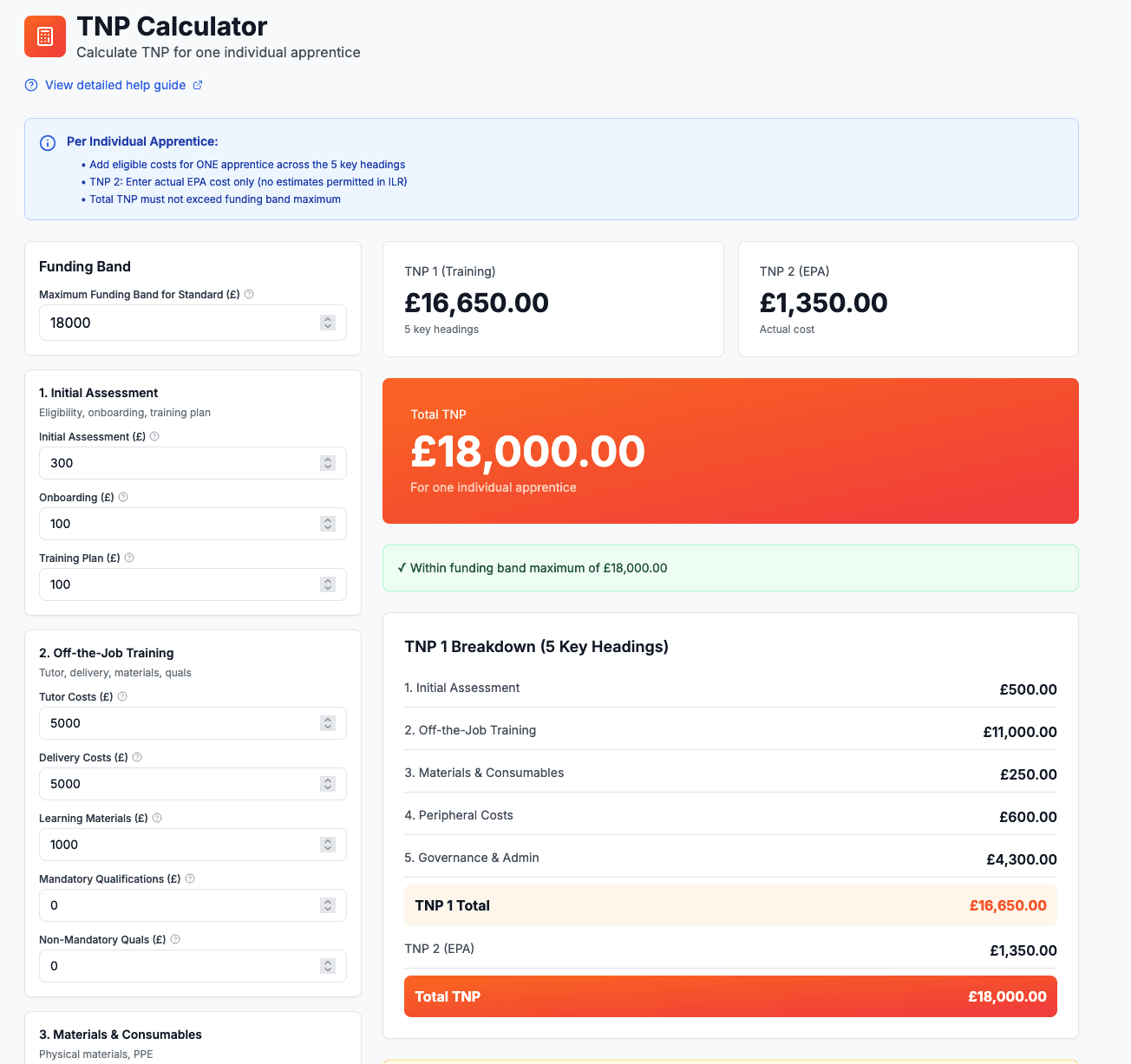
Validate against sector benchmarks. If your calculations suggest £4,000 TNP1 for a standard where established providers charge £6,000-7,000, either you've found remarkable efficiencies, or more likely, you've missed costs. Conversely, if you're significantly higher than market, scrutinise where additional costs arise and whether employers will pay premium pricing for your specific value proposition.
Build contingency for variations. Not every apprentice follows the ideal pathway—some need more support, take longer, or require additional input. A 10-15% contingency within your pricing prevents individual high-cost apprentices from eliminating profit across your entire cohort.
Review annually. Delivery costs change—salary increases, resource prices fluctuate, funding bands get reviewed. An annual TNP1 review ensures pricing remains sustainable. If costs have genuinely increased but market prices haven't, investigate efficiency improvements or consider whether the standard remains viable at current volumes.
Documentation for Audit Compliance
Maintain detailed cost calculations showing how you arrived at TNP1 figures. Break down teaching hours multiplied by rates, list coaching visit frequency and duration, document assessment time allocations, evidence learning support percentages, and itemise resource costs with invoices or purchase records. Auditors want to see methodology, not just final figures.
Store evidence of legitimate cost inclusion. Salary scales and employment cost breakdowns prove staff cost claims, supplier invoices evidence resource purchases, skills coach visit logs demonstrate coaching hours, and apprentice support records justify learning support costs. Without supporting documentation, auditors may disallow costs even if they were genuinely incurred.
Track actual costs against projected costs. If you calculated TNP1 assuming 400 teaching hours but delivered 600, understand why and whether your initial calculation was wrong or circumstances changed. This learning improves future TNP1 accuracy and demonstrates to auditors that you actively manage costs rather than plucking figures from thin air.
The Bottom Line
TNP1 calculates training and on-programme assessment costs using five eligible headings: teaching delivery, coaching and mentoring, on-programme assessment, learning support, and training resources. Costs must be directly attributable to apprenticeship delivery, reasonable, and properly evidenced for audit purposes. TNP1 plus TNP2 cannot exceed funding band maximums unless employers pay top-up costs.
Sustainable TNP1 calculation requires detailed time-based costing, realistic loaded rates including all employment costs, market awareness of competitive pricing, and annual review as costs and funding evolve. Document all calculations thoroughly and maintain supporting evidence for audit compliance, as funding bodies increasingly scrutinise pricing to ensure levy and co-investment money achieves value.
Accurate TNP1 ensures financial viability whilst remaining competitive and compliant. Underpricing loses money on every apprentice and threatens organisational sustainability. Overpricing breaches funding rules and makes you uncompetitive. Getting it right requires diligence, detailed analysis, and regular review—but the alternative of guessing or copying competitors without understanding underlying cost drivers inevitably leads to either losses or audit issues.
💷 Calculate TNP1 Accurately Every Time
TNP1 calculations must follow strict DfE rules across five cost headings. Funding Fox guides you through each step with built-in validation, ensuring your costs are eligible, properly categorised, and within funding band limits.
Start your free trial today and get TNP1 right:
✅ Five-heading cost breakdown matches official DfE requirements
✅ Real-time validation checks eligibility and funding band limits
✅ Built-in guidance explains what costs belong in each heading
✅ Audit-ready records stored securely for compliance reviews
Frequently Asked Questions
Q:What is TNP1 in apprenticeship funding?
TNP1 is the training and on-programme assessment cost—the first component of Total Negotiated Price. It covers all teaching, coaching, mentoring, and formative assessment during the apprenticeship, excluding end-point assessment which is TNP2.
Q:What costs can be included in TNP1?
Five eligible headings: teaching and learning delivery, coaching and mentoring, on-programme assessment, learning support, and training resources. Costs must directly relate to apprenticeship delivery and be reasonable, justifiable, and properly evidenced.
Q:Can TNP1 exceed the funding band maximum?
No—TNP1 plus TNP2 must not exceed the funding band maximum for that standard. If your costs genuinely exceed the band, you can charge employers the difference, but government funding caps at the maximum regardless of actual costs.
Q:How often should TNP1 be reviewed?
Review annually or when significant cost changes occur. Funding bands update periodically, delivery models evolve, and resource costs fluctuate. Regular review ensures pricing remains competitive whilst covering genuine costs.