
Learner Eligibility Systems & Process Check Tool
Training providers face mounting pressure to demonstrate robust learner eligibility systems that satisfy DfE auditors, DfE assurance reviewers, and Ofsted inspectors. A single eligibility verification failure—an unverified identity, questionable residency evidence, or inadequately documented employment status—can trigger funding claw-backs, qualification downgrades, or increased scrutiny across your entire provision. Yet many providers lack structured processes for consistently verifying eligibility across all programme starts, relying instead on informal checks that work well until an audit exposes gaps.
The Learner Eligibility Systems & Process Check addresses this challenge with a comprehensive, structured approach to eligibility verification. Built by compliance experts who've worked with hundreds of providers through DfE audits and DfE reviews, this checklist covers every aspect of eligibility: identity verification systems, residency checking processes, employment verification procedures, quality assurance controls, record-keeping standards, and audit preparation protocols. Rather than scrambling to evidence compliance when auditors arrive, you methodically build robust systems that prevent issues before they surface.
Available now in Funding Fox, this checklist transforms eligibility compliance from a reactive concern into a managed process. Work through it systematically with your team, document current practices, identify gaps, assign remediation actions, and track progress until every control is evidenced and tested. Whether you're preparing for an imminent audit, onboarding new compliance staff, or simply tightening procedures after previous findings, this checklist provides the structure and accountability that robust eligibility systems require.
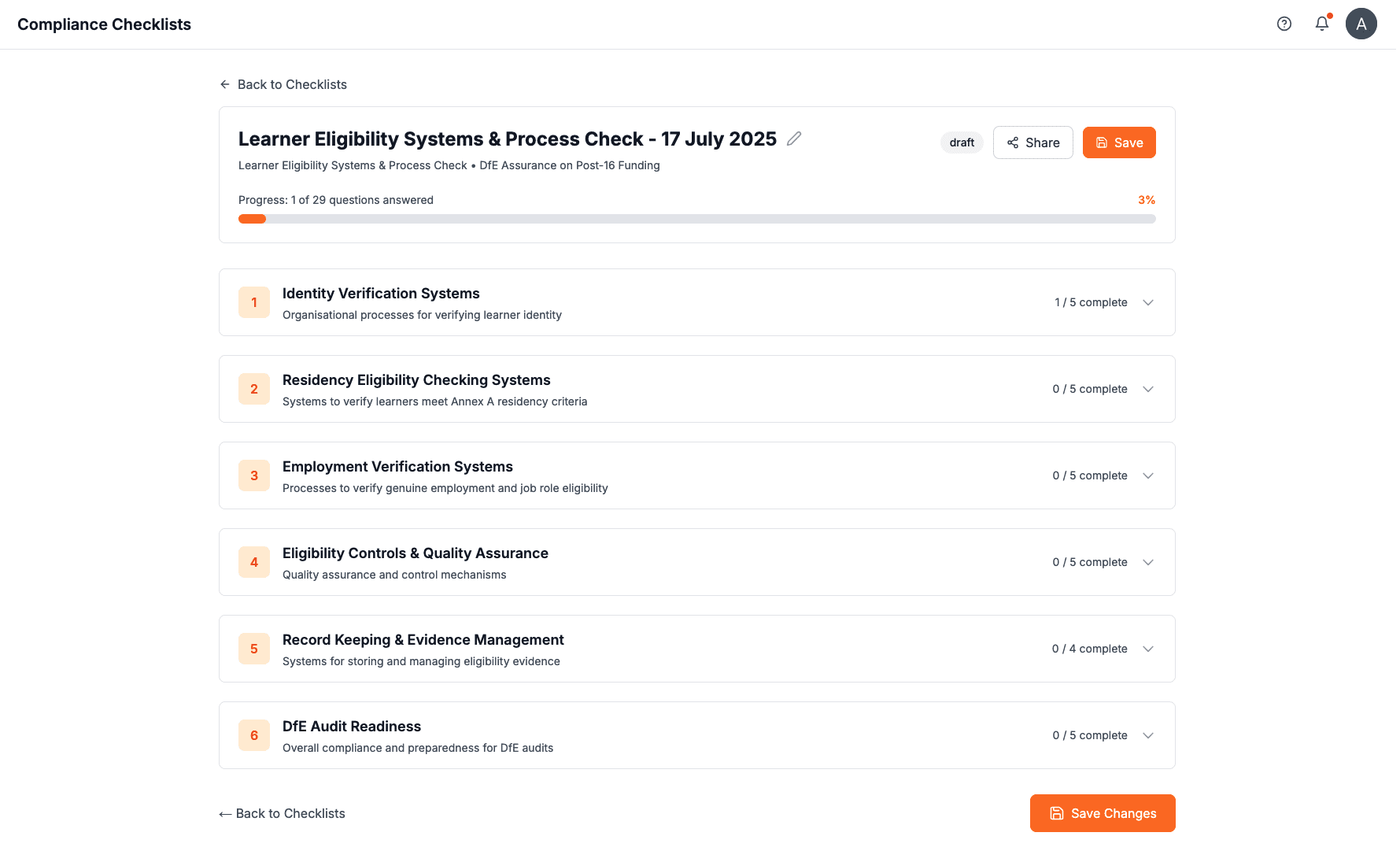
What the Checklist Covers
Identity Verification Systems
The checklist begins with identity verification—the foundation of learner eligibility. You'll document how your organisation verifies learner identity, which identification documents you accept, who is authorised to verify documents, and how you prevent identity fraud. Questions address both initial verification at enrolment and ongoing identity checks throughout programme delivery.
Key areas include documented procedures for identity verification, accepted document lists aligned with Right to Work requirements, staff training on spotting fraudulent documents, secure storage of identification evidence, and processes for verifying identity before learning starts. The checklist also covers digital identity verification tools, remote verification procedures for distance learners, and exception processes when standard documentation isn't available.
You'll create an action plan addressing any gaps: updating identity verification procedures, training staff on document checking, implementing digital verification tools, or reviewing storage security. Each action can be assigned to specific team members with target dates and priority levels, ensuring systematic resolution rather than vague commitments to "improve processes".
Residency Eligibility Checking
Residency requirements determine funding eligibility, making robust verification essential. This section walks through how you verify UK/EEA residency, assess three-year residency requirements, handle settled status for EEA nationals, and document residency evidence. With immigration rules constantly evolving and settled status creating new verification challenges, systematic residency checking prevents funding errors.
Questions address: documented residency verification procedures, evidence requirements for different residency categories, staff understanding of residency rules, tracking changes in residency status during programmes, and evidence retention. You'll also examine how you verify residency for remote learners, handle complex cases like asylum seekers or refugees, and ensure ILR coding accurately reflects verified residency status.
Action plans might include: creating residency verification guides, implementing residency status tracking systems, training staff on settled status verification, or developing escalation processes for complex cases. Priority flagging ensures urgent compliance gaps receive immediate attention whilst longer-term improvements progress systematically.
Employment Verification Systems
For apprenticeships, employment verification is critical—apprentices must be genuinely employed in eligible roles, with contracts demonstrating substantive employment rather than contrived arrangements. This section examines how you verify employment status, validate employer legitimacy, confirm job roles align with apprenticeship standards, and monitor employment throughout programmes.
Key questions cover: employment verification procedures, minimum weekly hours requirements, evidence of genuine employment versus artificial arrangements, employer eligibility checks, contract verification, and processes for handling employment changes mid-programme. You'll also address how you verify employment for complex situations like agency workers, self-employed apprentices, or multiple employers.
Actions might include: implementing employer verification checks, creating guidance on identifying artificial arrangements, developing employment change protocols, or enhancing ILR coding accuracy for employment data. With DfE increasingly scrutinising employment legitimacy, robust employment verification systems are non-negotiable.
Quality Assurance & Controls
Eligibility verification means nothing without quality assurance ensuring processes actually work. This section examines your quality controls: internal audit processes, sampling strategies, exception reporting, corrective action tracking, and management oversight. You'll assess whether eligibility checking happens consistently across all enrolments, staff follow documented procedures, and gaps trigger remediation rather than merely being noted.
Questions address: internal audit frequency and scope, sampling methodologies that identify verification failures, escalation processes when staff identify issues, management reporting on eligibility compliance, tracking metrics like verification completion rates, and periodic procedure reviews ensuring processes remain current with rule changes.
Action plans might focus on: implementing regular eligibility audits, creating sampling frameworks, developing escalation procedures, enhancing management dashboards, or scheduling periodic procedure reviews. Quality assurance transforms eligibility checking from individual staff responsibility into systematic organisational control.
Record Keeping & Evidence Management
DfE auditors demand evidence—not assertions—of eligibility verification. This section examines your record-keeping: what evidence you retain, how long you keep it, where it's stored, who can access it, and how quickly you can retrieve it during audits. Excellent verification procedures mean little if evidence is lost, misfiled, or inaccessible when auditors arrive.
Key areas include: documented evidence retention policies, secure storage systems (physical and digital), access controls protecting personal data, indexing enabling rapid retrieval, backup procedures preventing evidence loss, and GDPR compliance for retaining learner data. You'll also address how you manage evidence for learners who withdraw, transfer, or complete programmes.
Actions might include: implementing document management systems, creating retention schedules, training staff on evidence filing, conducting accessibility tests simulating audit requests, or reviewing GDPR compliance. Evidence you can't produce during audits might as well not exist—robust record-keeping ensures verification evidence supports compliance claims.
DfE Audit Readiness
The final section addresses audit preparation: how you'd respond to DfE notification, what evidence you'd present, how you'd explain your systems, and how confident you are in your processes. Rather than waiting for audit stress to reveal gaps, you proactively assess readiness and address weaknesses whilst time permits thorough remediation.
Questions cover: mock audit processes testing evidence retrieval, staff awareness of audit procedures, designated audit coordinators who understand systems holistically, evidence packs demonstrating systematic controls, and narrative explanations showing why your systems satisfy assurance requirements. You'll also examine how you handle audit findings, track remediation actions, and prevent recurrence of identified issues.
Action plans might include: conducting mock audits, creating audit evidence packs, training audit coordinators, developing audit response procedures, or implementing findings-tracking systems. Audit readiness isn't achieved the day DfE sends notification—it's built through systematic preparation that removes uncertainty and demonstrates control.
How It Benefits Users
Systematic Gap Identification
Working through the checklist reveals gaps you might not recognise exist. Perhaps identity verification happens inconsistently across different campuses, residency evidence isn't standardised, employment verification relies on informal checks, or evidence retention varies by staff member. The checklist makes implicit processes explicit, highlighting where procedures are unclear, undocumented, or unevenly applied.
This systematic review prevents the uncomfortable discovery of gaps during audits when remediation options are limited and stakes are high. Instead, you identify weaknesses whilst time permits thoughtful fixes, staff training, and thorough testing. Early gap identification converts potential audit findings into managed improvement projects.
Team Collaboration & Accountability
Eligibility compliance isn't one person's responsibility—it requires coordinated effort across enrolment staff, quality teams, ILR specialists, and management. The checklist's sharing features enable collaborative completion where team members contribute their specialist knowledge, document current practices from their perspectives, and collectively identify improvement opportunities.
Action assignment transforms vague commitments into accountable tasks. Rather than "we should improve identity verification" being a meeting note that's forgotten, it becomes an assigned action with an owner, target date, and progress tracking. Team members receive notifications about their assigned actions, keeping compliance work visible and progressing rather than languishing on to-do lists.
Evidence of Systematic Controls
Completing the checklist creates audit evidence itself—documentation showing you systematically reviewed eligibility systems, identified gaps, implemented controls, and verified they work. When DfE asks "How do you ensure learner eligibility?", you don't offer vague assurances; you demonstrate a structured review process, documented controls, testing evidence, and continuous improvement tracking.
This documented approach satisfies auditor expectations that controls are systematic rather than ad-hoc. Auditors see you take eligibility seriously, have thought through requirements comprehensively, and maintain evidence supporting compliance claims. The checklist transforms eligibility from an administrative task into a managed process with visible governance.
Continuous Improvement Framework
Eligibility requirements evolve—immigration rules change, funding guidance updates, new fraud patterns emerge. The checklist isn't a one-time exercise; it's a framework for periodic review ensuring procedures remain current. Schedule annual checklist reviews, update action plans addressing new requirements, and track improvements over time.
This continuous approach prevents procedures becoming outdated. Rather than discovering during audits that your 2020 residency checks don't address 2025 settled status requirements, periodic checklist reviews identify currency gaps when they emerge. Eligibility compliance becomes an ongoing management process rather than an occasional crisis response.
Staff Training & Onboarding
New compliance staff need to understand eligibility systems quickly. The checklist provides structured onboarding, walking new team members through each verification area, explaining requirements, documenting current procedures, and showing where controls exist. Rather than hoping new starters absorb eligibility knowledge through osmosis, you provide systematic introduction covering all critical areas.
Experienced staff benefit too—checklist completion often reveals that long-standing team members have developed personalised verification approaches that deviate from official procedures. Working through the checklist together surfaces these variations, enabling discussion about which approaches should be standardised and which represent legitimate process improvements that should be adopted organisation-wide.
The Bottom Line
The Learner Eligibility Systems & Process Check provides comprehensive, structured verification of your eligibility controls across identity verification, residency checking, employment verification, quality assurance, record keeping, and audit readiness. Rather than hoping your eligibility systems satisfy DfE requirements, you systematically assess them, identify gaps, assign remediation actions, and track progress until every control is documented and tested.
Available now in Funding Fox, this checklist supports team collaboration with sharing, action assignment, progress tracking, and notification features that keep compliance work moving. Whether you're preparing for imminent audits, onboarding new compliance staff, addressing previous findings, or simply tightening procedures proactively, this checklist provides structure and accountability that eligibility compliance requires.
Don't wait for audit notification to discover eligibility gaps. Work through this checklist systematically, address weaknesses whilst time permits thorough remediation, and build confidence that your verification systems satisfy DfE assurance requirements. Eligibility compliance shouldn't cause stress—with proper systems, it becomes a managed process demonstrating your commitment to funding rule adherence and learner protection.
✅ Start Your Eligibility Systems Check Today
The Learner Eligibility Systems & Process Check is available now in Funding Fox, ready for you and your team to complete collaboratively.
Access the checklist and strengthen your compliance:
✅ Comprehensive coverage of all DfE eligibility requirements
✅ Team collaboration with sharing and action assignment
✅ Progress tracking showing completion status
✅ Action notifications keeping team members accountable
Frequently Asked Questions
Q:What is the Learner Eligibility Systems & Process Check?
It's a comprehensive compliance checklist that walks training providers through all required systems and processes for verifying learner eligibility. Covering identity verification, residency checks, employment verification, quality controls, evidence management, and audit preparation, it ensures you meet DfE Post-16 Funding Assurance requirements.
Q:Who should use this checklist?
Any training provider delivering apprenticeships or other DfE-funded programmes. It's particularly valuable for quality teams, compliance managers, and organisations preparing for DfE audits or DfE assurance visits.
Q:Can I share the checklist with my team?
Yes! The checklist supports team collaboration. You can share it with colleagues, assign actions to specific team members, and track progress together. Everyone sees the same checklist and can contribute to completing it.
Q:How does the action plan feature work?
Each question includes an action plan where you can create follow-up tasks. Assign actions to team members, set target dates, track progress with notes, and prioritise by urgency. Your team receives notifications about assigned actions, keeping everyone aligned on compliance tasks.