
8 Audit-Ready Checklists for 2025-26 Funding Rules
When DfE auditors arrive, they ask one devastating question: "Can you show me the evidence?" Not your policies, not your understanding of the rules—the actual, documented, quantifiable evidence that proves compliance for every apprentice. Training providers consistently fail audits not because they misunderstand funding rules, but because they cannot produce evidence within the timeframes auditors demand.
A missing employer agreement, undocumented initial assessment outcome, insufficient OTJT tracking, or absent progress review records can trigger funding claw-backs worth hundreds of thousands of pounds. The evidence gap—knowing what should happen versus proving it actually happened—represents the single largest audit risk most providers face.
The 2025-26 Funding Rules Evidence Checklist Templates directly address this challenge. These 8 templates extract every requirement from the official "Evidence requirements" boxes in the funding rules document. Each of the 114 questions follows a consistent format: "Do you have a process to [exact evidence requirement], and can you provide evidence to auditors for each learner?" This eliminates ambiguity, ensures complete coverage, and creates an audit-ready evidence framework.
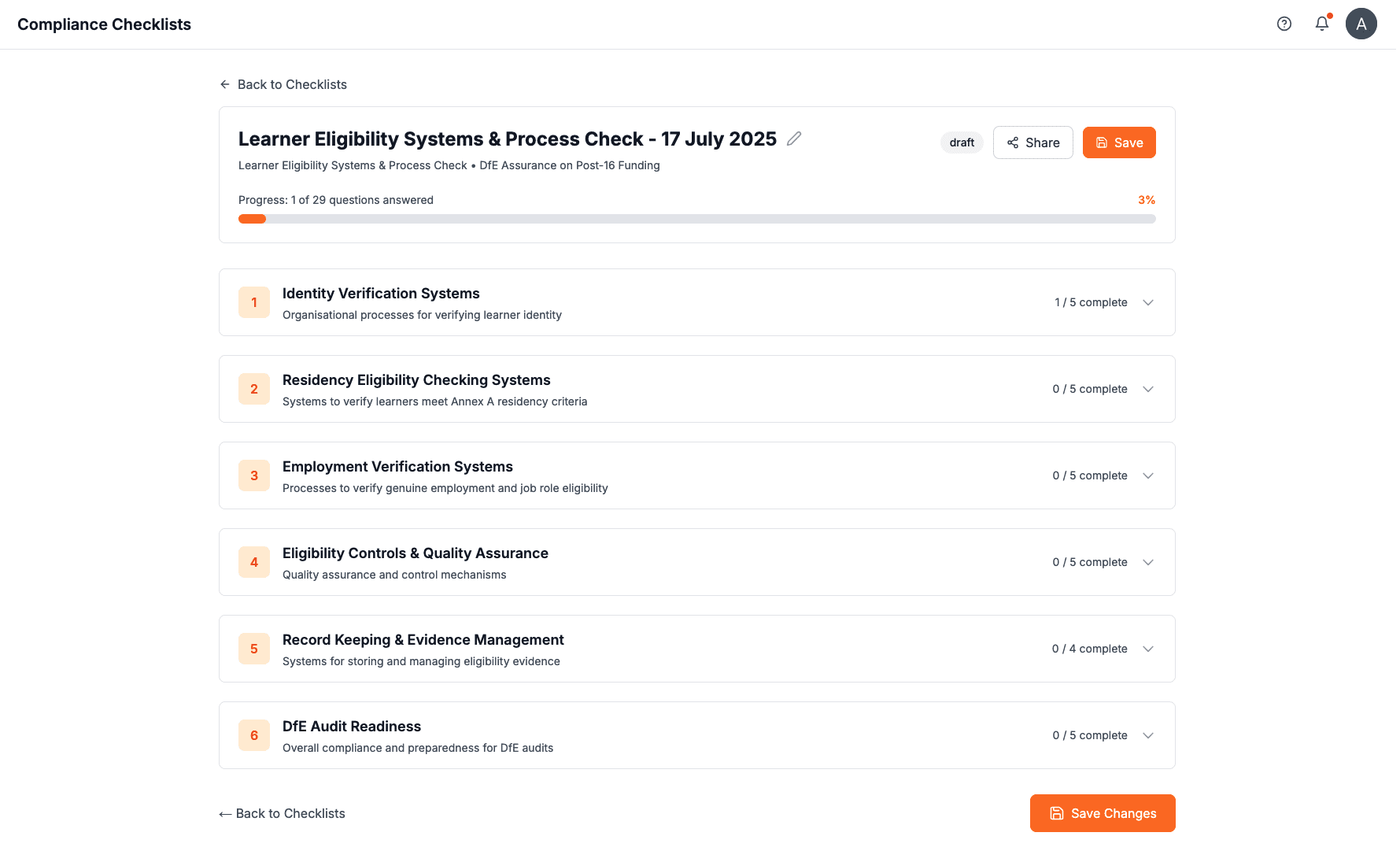
The 8 Templates
1. Initial Assessment & Outcome Evidence (37 Questions)
Initial assessment failures represent the single largest category of audit findings. This template covers all five initial assessment areas: learner eligibility (7 questions), prior learning (9 questions), learning support (5 questions), English & maths (7 questions), and outcome documentation (6 questions). Plus 3 audit readiness questions including the critical test: can you produce complete initial assessment evidence for any apprentice within 24 hours?
NEW for 2025-26: After completing all 4 initial assessment areas, can you evidence the individual requires significant new knowledge, skills and behaviours for occupational competence? This requirement was reinstated after being removed in 2023-24.
2. Programme Eligibility Systems (28 Questions)
Programme eligibility determines whether the apprenticeship itself is fundable. This template highlights critical 2025-26 policy changes: minimum duration reduced to 8 months (not 12), OTJT hours now published per standard rather than calculated as 20% of duration, flexible OTJT delivery, and new requirement for employer statements when actual OTJT hours are less than planned (reinstated in Version 2).
Questions verify: employment contracts cover the full period including EPA, apprenticeship agreements meet paragraph 65 requirements, minimum wage compliance, 8-month minimum duration, and planned OTJT hours meet published minimums. The absolute floor is 187 hours and 8 months—neither can be breached even with prior learning.
3. OTJT & Training Plan Evidence (14 Questions)
Off-the-job training represents the largest single area of funding recovery. Providers claim delivery but cannot produce quantifiable evidence. This template covers OTJT planning (6 questions), delivery tracking (3 questions), and training plan requirements (5 questions).
Critical requirements: planned OTJT hours documented on training plan and ILR and employer's apprenticeship agreement (all aligned), delivery evidence is quantifiable and excludes paragraph 77 ineligible activities (progress reviews, initial assessment, exams), training plans signed before delivery begins or within 42-day qualifying period, and employer confirmation of release during normal working hours.
Funds are at risk of recovery if OTJT policy not met.
4. Progress Reviews Evidence (11 Questions)
Progress reviews represent a persistent audit failure. Providers claim reviews happen but cannot evidence they occurred every 12 weeks, covered all paragraph 96 requirements, or involved the employer. This template ensures reviews are evidenced not just conducted.
Questions cover the six paragraph 96 mandated elements: checking progress against previous actions, discussing workplace learning evidence, checking OTJT progress and slippage, updating training plans, allowing concerns discussion, and documenting next actions. Plus verification that reviews occur every 12 weeks, employer attends in the majority of occurrences, and summaries are signed by at least provider and apprentice.
5. What Can Be Funded Evidence (5 Questions)
Ineligible cost claims represent serious fraud risk. This template ensures pricing is evidenced, justified, and compliant with paragraph 102's ~40-item exclusions list.
Critical exclusions: apprentice wages, travel, accommodation, PPE, DBS checks, employer CPD, capital purchases, financial inducements, E&M (funded separately), and learning support (funded separately). Questions verify TNP1 breakdown against paragraph 98 headings, TNP2 contains no estimates, and no ineligible costs included.
6. Paying for Apprenticeship Evidence (11 Questions)
Payment arrangements create significant audit risk. Questions cover: signed contracts with price details, evidence price changes agreed in advance, co-investment collection (5% visible in financial systems), co-investment exemptions (16-21 year-olds, 22-24 with EHC/care leavers), apprentice contribution prohibition statement, and MFA declarations for levy transfers.
Critical: Full co-investment must be collected by the provider's final ILR submission for the academic year of completion (paragraph 187.4).
7. Delivery Models Evidence (2 Questions)
For levy fund transfers: can you hold confirmation of the sending employer? Can you produce this within 24 hours for any transfer-funded apprentice?
8. Change of Circumstance Evidence (6 Questions)
Covers redundancy evidence (dismissal notice or reasonable evidence, reasonable efforts to find new employer), KIT/SPLIT day agreements for maternity/adoption/parental leave (signed by all parties per paragraph 286), ULN accuracy, and comprehensive evidence retention per paragraph 308.
Who Benefits and How
Quality & Compliance Managers: These templates are the audit. Every question derives from an Evidence requirements box. Use them to conduct internal audits, identify gaps, assign remediation tasks, and track progress until every control is evidenced.
Senior Leadership Teams: Translate 308 pages of policy into 114 answerable questions. Review completion rates and risk flags for governance oversight without drowning in detail. Report: "95% of Initial Assessment evidence complete, 3 high-risk gaps in remediation."
Programme & Curriculum Managers: Understand how evidence requirements constrain programme design. Published OTJT hours set minimum delivery volumes, 8-month minimum establishes duration floors, training plan signatures determine when funding can be claimed.
Tutors & Assessors: Learn what evidence must be retained. If you deliver training, what must be recorded? If you conduct a review, what must be documented? Templates specify quantifiable records with activity descriptions enabling cross-checks against training plans.
Employer Engagement Teams: Understand employer commitments before signing contracts. Employment must cover EPA periods, employers must agree release for OTJT, co-investment applies unless exemptions met, apprentices cannot be charged for eligible costs.
Data & MIS Teams: Understand evidence-to-ILR relationships. Before submitting learning starts, verify initial assessment complete. Before submitting OTJT hours, verify training plan signed. Before submitting co-investment coding, verify invoice and payment exist.
Subcontractors: Templates apply equally to subcontracted delivery. Align evidence practices with main provider expectations, establish submission schedules, verify records meet audit standards.
The 24-Hour Evidence Test
Every template includes an audit readiness question: Can you produce complete evidence for any apprentice within 24 hours? This isn't hypothetical—it's what auditors demand.
Run the test monthly: quality teams select 5 random apprentices, attempt to gather all required evidence, time retrieval, document gaps. Track results over time: are retrieval times decreasing? Are the same evidence types repeatedly missing? Use results to drive improvements: centralise storage if retrieval takes days, strengthen capture processes if evidence missing, provide training if staff struggle.
The test transforms compliance from a theoretical concern into a measurable operational capability.
Evidence Over Understanding
These templates embody a fundamental principle: compliance is about evidence, not understanding. Providers who understand funding rules perfectly still fail audits if they cannot prove compliance. Conversely, providers with less sophisticated understanding but robust evidence systems survive audits because they can demonstrate compliance regardless of staff knowledge.
The templates shift focus from "do we know the rules?" to "can we prove compliance?" Every question asks whether you have processes to create evidence and can produce it when demanded. This cultural shift—from knowledge to evidence, from understanding to proof—represents the difference between audit-ready organisations and those perpetually surprised by findings.
Getting Started
All 8 templates are available now in Funding Fox under the Check Templates section. Filter by Funding Rules 2025/26 category to view all templates, then select the area you want to assess.
Start with Template 1 (Initial Assessment)—the highest-risk area for most providers—and work systematically through to Template 8. Assign templates to appropriate teams: quality owns Templates 1 and 4, curriculum owns Templates 2 and 3, finance owns Templates 5 and 6, data teams support all templates.
Schedule monthly review meetings where teams report completion rates, evidence gaps, remediation progress, and persistent issues. Use action plan features to assign tasks, set deadlines, track completion, and maintain accountability.
Within 3 months of systematic use, you should be able to produce complete evidence for any apprentice within 24 hours and answer the devastating audit question—"Can you show me the evidence?"—with confidence rather than panic.
Start building your evidence framework today, before auditors arrive tomorrow.
Frequently Asked Questions
Q:What are the 8 funding rules checklist templates?
The templates cover: (1) Initial Assessment & Outcome Evidence, (2) Programme Eligibility Systems, (3) OTJT & Training Plan Evidence, (4) Progress Reviews, (5) What Can Be Funded, (6) Paying for Apprenticeship, (7) Delivery Models, and (8) Change of Circumstance. Together they contain 114 evidence-based questions extracted directly from DfE's Evidence requirements boxes.
Q:How are these different from reading the funding rules?
These checklists translate 308 pages of policy into actionable questions. Instead of reading 'providers must retain evidence of...', you answer 'Do you have a process to retain evidence and can you produce it for auditors?' Each question cites exact paragraph numbers for complete traceability.
Q:What are the key 2025-26 policy changes covered?
Major changes include: minimum duration reduced to 8 months (not 12), published OTJT hours per standard (no more 20% calculation), flexible OTJT delivery, employer statements required when actual < planned hours, and the reinstated requirement to evidence significant new knowledge, skills and behaviours.